Visit the Sampurna Website
Go to: www.sampurna.food
 Apply Now

The Sampurna Grand Challenge 2026 has been designed as a platform to bring together government, innovators, Farmer Producer Organisations (FPOs), markets, research institutions and investors to identify and scale practical, market-ready solutions that can meaningfully reduce post-harvest food loss in Karnataka.
The Sampurna Grand Challenge on Reducing Food Loss through Innovation in Karnataka seeks to spotlight and scale locally relevant innovative solutions that tackle food loss across the value chain.
The innovation challenge brings together key stakeholders across government, private sector and civil society to create a collaborative platform that transforms food loss challenges into opportunities for value creation, economic growth, and sustainable, nutrition-sensitive food systems.

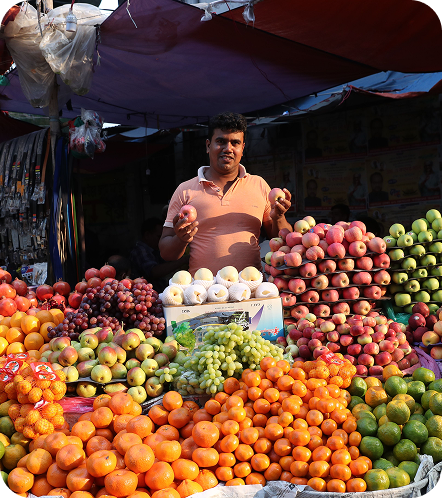
India loses an estimated ₹92,000 crore worth of food annually, with post-harvest losses accounting for a significant share, particularly in fruits and vegetables. Nearly one-third of food produced globally is lost before it reaches consumers, affecting farmer livelihoods, food affordability, nutrition security and climate impact.
Karnataka accounts for nearly 9.6% of the country’s horticultural area and about 7.2% of national horticultural production. Horticulture contributes nearly 30% of the state’s agricultural Gross Value Added.

Submit your application between 20 March – 18 May 2026
Start Your ApplicationUnderstanding the scale of food loss in Karnataka

Annual Food Loss in India

Post-Harvest Loss

National Horticulture
Production

Agricultural GVA Contribution
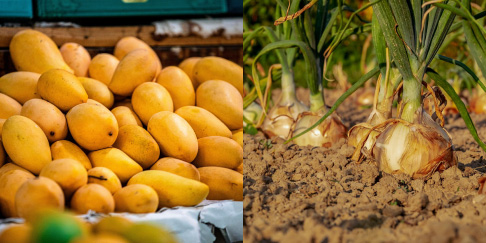
Karnataka is one of India’s leading horticulture-producing states, yet a significant share of harvested produce fails to translate into realised value.
An estimated 15–30% of fruits and vegetables are lost post-harvest due to systemic gaps in aggregation, storage, processing, logistics and market linkages.
Applications are invited for solutions addressing priority crops including Onion, Mango, Banana, Tomato, Grapes, Pomegranate and Pineapple.
The innovation challenge is structured around seven priority areas targeting different intervention points within the value chain.
While the challenge is organised into seven thematic categories, the horticulture value chain functions as an interconnected system. Many solutions will naturally span more than one category — and that is by design. A logistics platform may incorporate demand forecasting. A packaging innovation may enable cold-chain efficiency. An aggregation model may integrate finance and digital tools. Applicants are encouraged to apply under the category that best reflects their primary intervention, even where their solution addresses multiple areas.
The diagram above maps each of the seven challenge categories to the stage(s) of the value chain where they primarily intervene. Categories with wider bars — such as Digital Decision Systems and Innovative Financial Access — are cross-cutting enablers that operate across multiple stages. Narrower bars indicate categories anchored to a specific intervention point. Overlapping stages signal where solutions from different categories may complement or intersect.
Post-harvest losses in Karnataka are concentrated at the farm gate, where a sudden glut of produce — onions, tomatoes, bananas — meets insufficient infrastructure for sorting, cooling, and basic processing.
Without accessible packhouses or shared cooling, smallholders have no choice but to sell immediately, flooding local markets and accepting distress prices. Even modest improvements in on-farm handling — better grading, shaded storage, low-cost cooling — can significantly reduce spoilage and stabilise farmer incomes during peak harvest windows.
During peak harvest periods, the sudden surge in supply frequently overwhelms local handling capacity — leaving smallholders with little option but to sell immediately at whatever price the market offers.
Applications are invited for solutions across crops; however, the programme places special emphasis on the following crops: Onion, Mango, Banana, Tomato, Grapes, Pomegranate, and Pineapple.
Your solution focuses primarily on transport logistics, digital market tools, or finance — those are covered in other categories.
Apply NowInadequate packaging is a hidden but significant source of loss across Karnataka’s supply chains. Produce is routinely transported in thin jute sacks or open crates that offer little protection against bruise, dehydration, and contamination — damage that is invisible at the farm gate but results in rejections and discounts at the market. Better packaging protects physical quality, slows spoilage, and can signal to buyers that the produce meets a consistent standard. There is a growing demand for solutions that are both effective and environmentally sustainable.
Across Karnataka’s supply chains, a significant share of produce damage occurs not in the field but in transit — the result of inadequate containers and packaging that offer little protection against bruising, dehydration, or contamination.
Applications are invited for solutions across crops; however, the programme places special emphasis on the following crops: Onion, Mango, Banana, Tomato, Grapes, Pomegranate, and pineapple.
Your solution focuses primarily on transport logistics, digital market tools, or finance — those are covered in other categories.
Apply NowSlow and uncoordinated production after harvest is one of the most avoidable sources of loss in Karnataka. During peak season, trucks sit idle waiting for loads, roads to major mandis become congested, and perishables spend hours — or days — without cooling. Many smallholders have no reliable way to book transport or know when vehicles are available, forcing rushed, unoptimized trips that arrive at market either too early or too late. Coordinated logistics infrastructure — scheduling, load pooling, and cold-chain access — can significantly reduce time-in-transit and spoilage.
At peak season, the gap between farm-gate availability and market readiness is often measured in hours of preventable delay — trucks waiting idle, produce sitting unrefrigerated, and farmers bearing the cost of a system that was not designed for perishable volumes.
Applications are invited for solutions across crops; however, the programme places special emphasis on the following crops: Onion, Mango, Banana, Tomato, Grapes, Pomegranate, and pineapple.
Your solution focuses primarily on transport logistics, digital market tools, or finance — those are covered in other categories.
Apply NowKarnataka’s horticulture sector is dominated by smallholder farmers with fragmented landholdings and limited individual market power. Without collective structures, each farmer bears the full cost of transport, faces weak negotiating leverage, and must sell quickly regardless of price. Aggregation — whether through FPOs, village collection centres, or informal farmer groups — directly addresses these constraints by enabling volume-based contracts, shared logistics, and joint quality management. In areas where formal FPOs are still nascent, even simple community-led models can deliver significant impact.
Where farmers sell individually, they typically face higher transport costs, weaker bargaining positions, and greater pressure to sell quickly. Even modest collective structures — a shared collection point, a joint grading shed — can meaningfully shift these dynamics.
Applications are invited for solutions across crops; however, the programme places special emphasis on the following crops: Onion, Mango, Banana, Tomato, Grapes, Pomegranate, and pineapple.
Your solution focuses primarily on transport logistics, digital market tools, or finance — those are covered in other categories.
Apply NowEven where appropriate post-harvest technologies exist, many FPOs and small agri-enterprises in Karnataka cannot access the finance to adopt them. Conventional bank loans are designed for crop production — not for cold rooms, transport equipment, or packhouse upgrades — and are rarely disbursed in time for seasonal needs. Working capital gaps force farmers to sell at harvest-time lows rather than stores and wait for better prices. Innovative financial products tailored to the short cycles, seasonal cash flows, and asset profiles of horticulture enterprises are essential to enabling the adoption of loss-reducing solutions.
An FPO that cannot access short-term working capital during the harvest window may be unable to store produce, hire transport, or invest in basic handling improvements — forcing distress sales regardless of the quality of its produce.
Applications are invited for solutions across crops; however, the programme places special emphasis on the following crops: Onion, Mango, Banana, Tomato, Grapes, Pomegranate, and pineapple.
Your solution focuses primarily on transport logistics, digital market tools, or finance — those are covered in other categories.
Apply NowA significant share of post-harvest losses in Karnataka stems not only from infrastructure gaps but also from fragmented, delayed, and disconnected decision-making across the value chain. Farmers decide when to harvest without knowing storage availability. Traders dispatch trucks without knowing market conditions. FPOs sell without visibility on competing supply arrivals. These decisions — made in isolation across dozens of actors — create systemic inefficiencies: produce gluts, underutilised cold rooms, and avoidable spoilage. When farmers and supply chain actors have access to timely, integrated digital information, they make better decisions — and loses fall. What Karnataka needs are not just more data dashboards, but systems that connect actors and translate data into action.
When actors across the value chain make harvest, storage, and dispatch decisions in isolation — without shared information on supply volumes, market conditions, or infrastructure availability — the result is predictable: gluts, delays, and avoidable spoilage.
Applications are invited for solutions across crops; however, the programme places special emphasis on the following crops: Onion, Mango, Banana, Tomato, Grapes, Pomegranate, and pineapple.
Solutions that focus only on a single operational function (e.g. route optimization, warehouse management, or standalone price dashboards or single-function tools) are better suited to other categories (e.g. logistics optimization) unless they are embedded within a broader, integrated decision-making system. A standalone price dashboard, for example, may still qualify if it is designed to drive actionable decisions across multiple value chain actors.
Your solution is a standalone single-function tool — such as route optimisation only, or a price dashboard only — unless it is embedded within a broader, integrated decision system. Note: a standalone price dashboard may still qualify if it is designed to drive actionable decisions across multiple value chain actors.
Apply NowEven in well-functioning supply chains, a portion of Karnataka’s horticulture output is unmarketable in its fresh form — produce that is off-grade, over-ripe, blemished, or surplus to what primary markets can absorb. In the absence of structured secondary uses, this material is sold at deep discounts or discarded entirely. A circular economy approach reframes this waste as feedstock: surplus mangoes become puree; blemished onions become dehydrated flakes; pomegranate peel yields extract for nutraceuticals; organic waste becomes biogas or compost. Technologies and business models that unlock this secondary value streams convert losses into income — for farmers, processors, and communities.
A significant share of produce that fails to meet primary market standards is not inherently worthless — it represents raw material for processing, energy generation, or soil enrichment that, without structured secondary channels, simply goes to waste.
Applications are invited for solutions across crops; however, the programme places special emphasis on the following crops: Onion, Mango, Banana, Tomato, Grapes, Pomegranate, and pineapple.
Your solution is about primary marketing, packaging, or logistics unless it specifically applies to waste or surplus streams.
Apply NowEligible applicants include:


Applications are open to organisations at any stage of development.
Women-led organisations and youth innovators are strongly encouraged to apply.
Go to: www.sampurna.food
On the homepage, click on the “Applications” tab in the main menu.
Under the Applications section, you will see a list of active applications. Click on the Sampurna Grand Challenge 2026 application link.
You will be redirected to the Nutrition Connect website, where the official application forms are hosted.
Review the available challenge categories and choose the one that best fits your solution (based on your primary intervention area).
Before accessing the full form, fill out the Eligibility Checker to confirm your eligibility.
Complete all required sections, including:
Ensure you upload:
Click on “Submit Formal Application” to complete the process.
Ensure you submit your application before 31st May 2026.
20 March – 18 May 2026


25 May 2026
12 June 2026


15 – 27 June 2026
29 June – 6 July 2026


23 – 24 July 2026

Visibility and recognition through platforms.

Mentorship by domain experts to enhance business readiness.

Felicitation at a high-profile finale ceremony.

Financial awards as seed funding support.

Networking opportunities with investors and government stakeholders.